

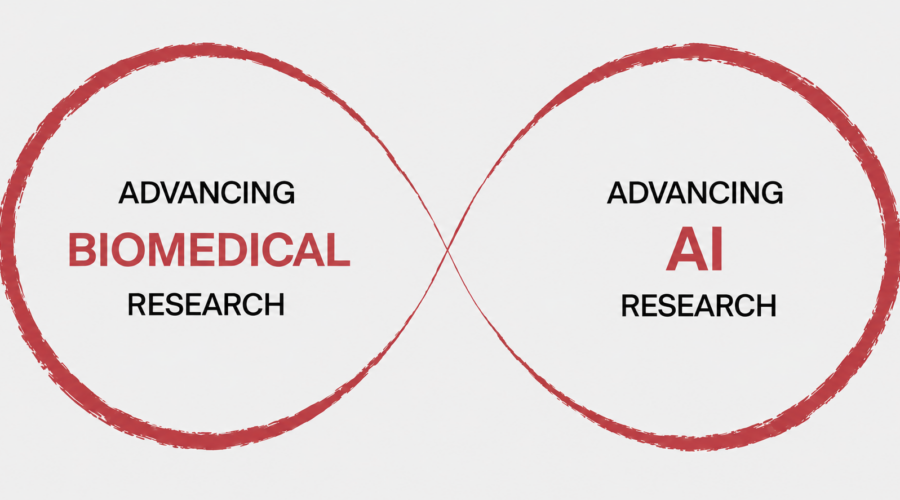
Our research brings together challenges in biomedicine and fundamental questions in AI. We develop multimodal and generative models to understand cells and tissues, predict their responses to perturbations, and enable new biological discoveries. In parallel, we advance machine learning by investigating how AI models represent knowledge, connect modalities, and generalize to new settings, using these insights to develop more capable and reliable methods. These two directions inform one another: biological questions inspire broadly applicable AI methods, while advances in AI open new possibilities for biomedical discovery.
Advancing AI research
Our research aims to advance both the capabilities of modern AI systems and our understanding of principles behind them. We develop methods that enable foundation models and agentic systems to acquire new capabilities. We investigate how representations learned across models and modalities relate to one another, and use these insights to guide efficient and effective alignment. Across these directions, we investigate the capabilities, limitations, and failure modes of modern AI systems, using these insights to develop more robust and generalizable learning principles.
Example publications:
- Rethinking Projector Training in Multimodal LLMs
- To Align or Not To Align: Check Your COMPASS Before You Train
- Revisiting the Platonic Representation Hypothesis: An Aristotelian View
- PACER: Acyclic Causal Discovery from Large-scale Interventional Data
- Meta-RL Induces Exploration in Language Agents
- When Weak LLMs Speak with Confidence, Preference Alignment Gets Stronger
- HeurekaBench: A Benchmarking Framework for AI Co-scientist
- With Limited Data for Multimodal Alignment, Let the STRUCTURE Guide You
- Weak-to-Strong Generalization under Distribution Shifts
- Large (Vision) Language Models are Unsupervised In-Context Learners
- Let Go of Your Labels with Unsupervised Transfer
- Cross-domain Open-world Discovery
- Fine-grained Classes and How to Find Them
- The Pursuit of Human Labeling: A New Perspective on Unsupervised Learning
- Open-World Semi-Supervised Learning
- Concept Learners for Few-Shot Learning
Advancing biomedical research
We develop multimodal and generative AI models to uncover new biological insights, with the goal of understanding cellular states, how cells organize into tissues, and how changes across these scales shape human health and disease. Our methods have been used to annotate global cell atlas consortia efforts aiming at creating comprehensive reference maps of all cell types such as HuBMAP and Fly Cell Atlas. Our lab is part of the ImmGen group and CIFAR Multiscale Human Program. We intensively collaborate with biologists, neuroscientists and medical researchers on cutting-edge problems.
Example publications:
- Generative modeling reveals the connection between cellular morphology and gene expression
- Tissue reassembly with generative AI
- Systema: a framework for evaluating genetic perturbation response prediction beyond systematic variation
- immgenT: A Comprehensive Reference of Convergent T-cell States in the Mouse
- Towards Universal Cell Embeddings: Integrating Single-cell RNA-seq Datasets across Species with SATURN
- Annotation of Spatially Resolved Single-cell Data with STELLAR
- MARS: Discovering Novel Cell Types across Heterogeneous Single-Cell Experiments
- Aging Fly Cell Atlas Identifies Exhaustive Aging Features at Cellular Resolution
- High Resolution Single Cell Maps Reveals Distinct Cell Organization and Function Across Different Regions of the Human Intestine
- Fly Cell Atlas: A Single-Cell Transcriptomic Atlas of the Adult Fruit Fly
- Single-Cell Transcriptomes of Developing and Adult Olfactory Receptor Neurons in Drosophila
- Temporal evolution of Single-Cell Transcriptomes of Drosophila Olfactory Projection Neurons
- The Landscape of Microbial Phenotypic Traits and Associated Genes